How do you set up nesting optimization in CAD software for less residual material?
Nesting optimization in CAD software ensures that you place parts on sheets or material blocks as efficiently as possible, leaving you with up to 30% less residual material. With smart algorithms and the right settings, you can drastically reduce material costs and increase your production efficiency. Do you have questions about implementing nesting optimization? Feel free to contact us.
High material costs eat up your profit margin
Many companies in metalworking and kitchen construction lose money every day due to inefficient material utilization. Without proper nesting optimization, you are literally throwing away expensive sheets and profiles as residual material. This can increase your material costs by 20-40% and weaken your competitive position. The solution lies in implementing professional CAD software with advanced nesting functions that automatically calculates the most efficient placement of parts.
Manual nesting planning costs you valuable production time
Puzzling parts manually on material sheets takes technicians hours a day and often leads to suboptimal results. This waste of time translates directly into higher labor costs and longer lead times. Modern CAD software with automatic nesting optimization can accomplish this task in seconds while delivering better results than manual planning.
What is nesting optimization and why is it important for the manufacturing industry?
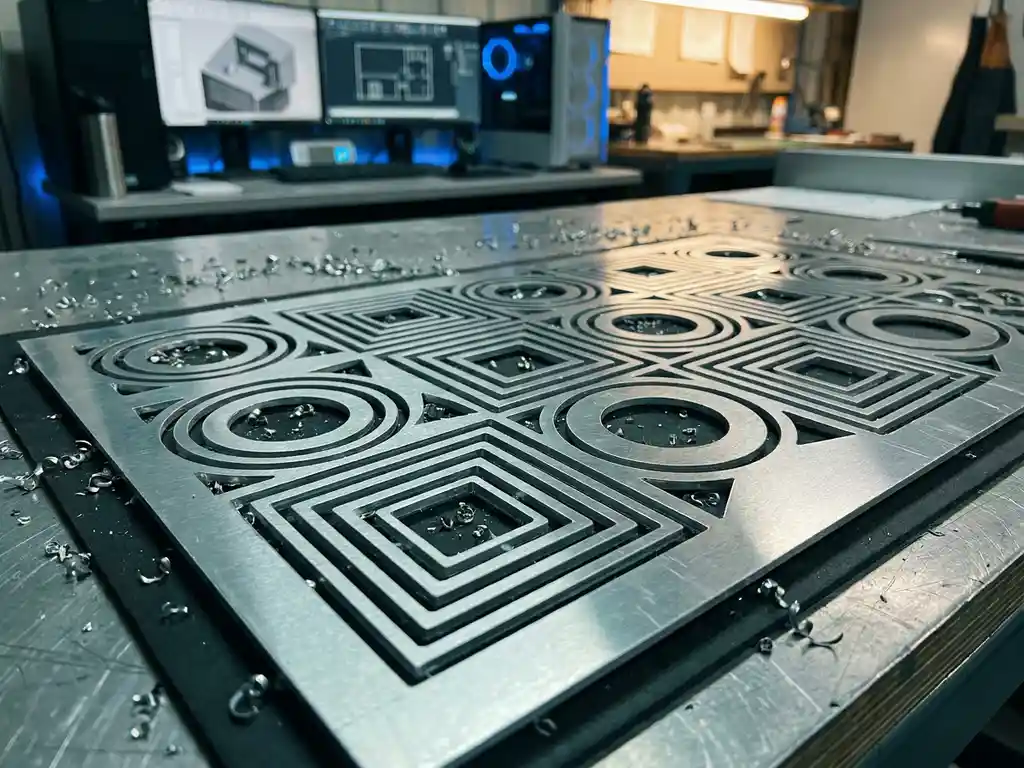
Nesting optimization is the process by which CAD software automatically calculates the most efficient placement of parts on material sheets. It minimizes residual material, reduces material costs and increases production efficiency through optimal material utilization.
In the manufacturing industry, material utilization directly determines your profitability. Companies working with expensive materials such as steel, aluminum or high-grade woods can reduce their material costs by 15-30% through smart nesting optimization. The software takes into account material dimensions, saw widths, grain directions and minimum distances between parts.
For industries such as mechanical engineering and interior design, nesting optimization is essential, as these industries often work with customization and small batches. Every sheet you can utilize more efficiently means direct cost savings and less waste.
How much material can you save with good nesting optimization?
Professional nesting optimization can reduce your material consumption by 15-30% compared to manual planning. The exact savings depend on your parts, material types and the complexity of your production.
The biggest savings are seen in companies that produce many different parts from the same type of material. Through clever combinations of large and small parts, you can minimize residual material. Modern algorithms can calculate thousands of possible combinations in seconds and select the most efficient variant.
In addition to material savings, you also benefit from lower inventory costs because you can more accurately estimate how much material you need. This reduces your working capital requirements and lowers your storage costs significantly.
Which CAD software offers the best nesting features?
The best CAD software for nesting optimization combines powerful algorithms with user-friendly interfaces and flexible parameter settings. Key features include automatic plate optimization, saw list generation and integration with manufacturing processes.
Professional CAD solutions offer advanced nesting algorithms that take into account material directions, saw widths and production-specific constraints. They can also automatically generate saw lists and NC codes, reducing the lead time from design to production.
The software must also be flexible in parameter settings so that you can tailor optimization to your specific production process and material requirements. Integration with ERP systems ensures that material consumption is automatically tracked in your inventory records.
How do you set nesting parameters correctly for optimal results?
Setting nesting parameters correctly begins with defining material dimensions, saw widths and minimum distances between parts. Also set grain directions and material-specific constraints for optimal results.
Start by entering your standard material dimensions and stock sizes. Set the cutting width to match your actual cutting tool, usually between 2 and 5 mm. Define minimum distances between parts to avoid damage during cutting.
For materials with grain direction, such as wood or composites, set the desired fiber direction per part. This avoids problems with strength and finish. Also configure priorities: do you want maximum material utilization or minimum cutting time? This choice affects how the software performs the optimization.
What factors influence the quality of your nesting results?
The quality of nesting results is determined by material data, part complexity, parameter settings, and the quality of your CAD geometry. Accurate input data and realistic constraints lead to better optimization.
Material data is crucial: incorrect dimensions or missing constraints lead to infeasible nesting results. Make sure your material library is up-to-date with current supplier specifications and stock sizes.
The complexity of your parts also plays a big role. Simple rectangular shapes are easier to optimize than complex contours with cut-outs. When designing, consider nesting-friendly shapes whenever possible.
Finally, the quality of your CAD geometry is important. Parts with closed contours, correct dimensions and without excess lines yield better nesting results than sloppy drawings.
How IronCAD helps with nesting optimization
IronCAD offers advanced nesting optimization that automatically maximizes your material utilization. The software generates saw lists, optimizes plate layouts and produces directly usable NC codes for your production process.
With IronCAD, you benefit from:
- Automatic plate optimization that saves up to 30% material
- Intelligent algorithms that take into account material directions and saw widths
- Direct link between 3D design and production plans
- Automated saw lists and reports
- Seamless integration with your ERP system for inventory management
Want to experience for yourself how IronCAD can reduce your material costs? Contact us for a personal demonstration of the nesting features.