Does CAD software support material testing?
Modern CAD software has dramatically changed the way we design and develop products. Whereas engineers used to rely entirely on physical prototypes and costly testing procedures, digital tools now offer powerful capabilities for virtual material testing. This development enables companies in the manufacturing industry to make crucial decisions about material use and product performance as early as the design phase.
In this article, you will discover how CAD software supports material testing, the benefits it brings to your production process and the limits of this technology. We discuss practical applications and give you insight into how to make the most of these capabilities.
What are material tests in CAD software?
Material testing within CAD environments involves simulations that predict the behavior of materials under various conditions. These virtual tests analyze factors such as strength, flexibility, thermal properties and durability of materials before actual production.
CAD software uses sophisticated algorithms to calculate how materials respond to forces, temperature changes, pressure and other external factors. These simulation capabilities range from simple strength analyses to complex multiphysics simulations that evaluate multiple material properties simultaneously.
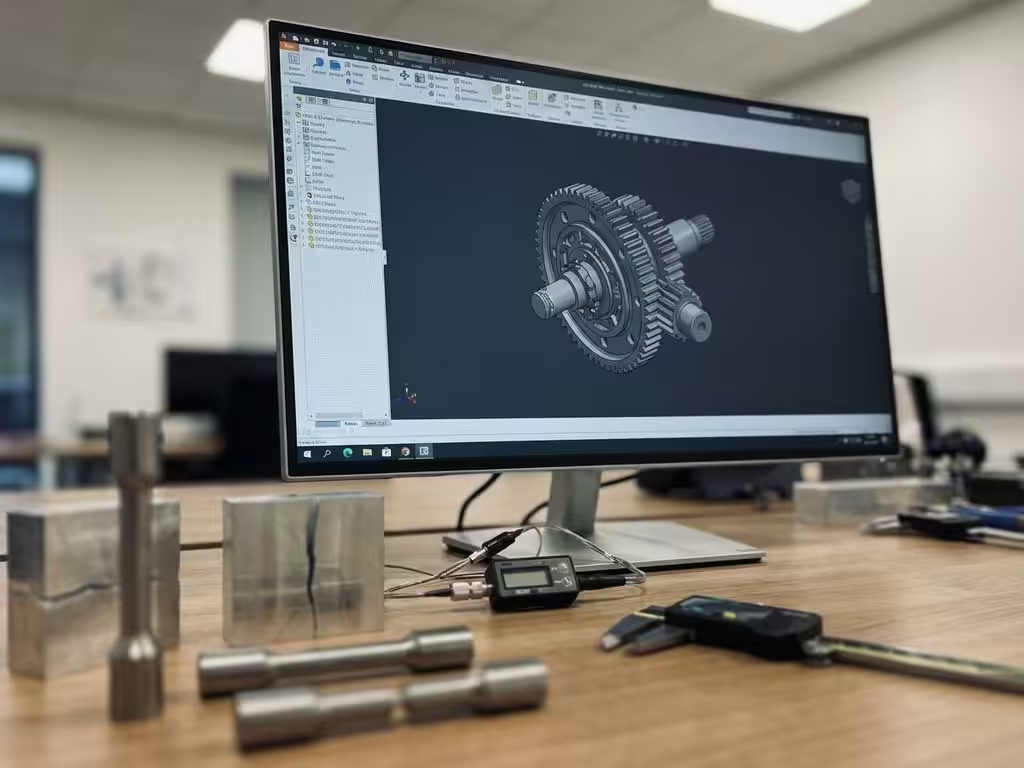
The main difference between virtual and physical testing lies in accessibility and speed. Whereas physical tests require time, materials and specialized equipment, virtual tests can be performed within minutes. Moreover, you can test unlimited variations without wasting material or additional production costs.
Virtual materials testing also provides the ability to simulate extreme scenarios that would be difficult or dangerous in a physical testing environment. Consider testing materials under extreme temperatures or at extremely high loads.
How IronCAD integrates material properties
IronCAD offers extensive material analysis functionality that is seamlessly integrated into the design environment. The software features an extensive material library with predefined properties for commonly used materials in the manufacturing industry.
Designers can easily assign material properties to specific parts of their 3D models. These properties include density, modulus of elasticity, thermal conductivity and other relevant parameters critical for accurate simulations.
The software allows you to define custom materials when standard options are not sufficient. You can enter specific properties based on vendor data or your own test results, making the simulations more appropriate for your specific applications.
IronCAD integrates this material data directly into the design process, giving you real-time feedback on the suitability of material combinations. This helps make educated decisions during the design process.
Benefits of virtual materials testing for the manufacturing industry
The cost savings from virtual materials testing are significant. You eliminate the cost of physical prototypes, test materials and laboratory time. In addition, you can identify potential problems before investing in expensive manufacturing processes.
Time savings is another crucial advantage. Where physical tests can take weeks, virtual simulations deliver results within hours. This acceleration of the development process allows you to respond faster to market changes and customer requirements.
Risk reduction through early material validation prevents costly errors in later stages of the production process. You can calculate different material scenarios and select the optimal combination before production commits.
For production efficiency, this means you can start manufacturing with more confidence. The chance of unexpected material behavior or manufacturing errors decreases dramatically when materials are virtually validated.
Virtual testing also makes it possible to investigate innovative material combinations that would otherwise be too risky to put directly into production. This opens up new opportunities for product optimization and cost savings.
Limitations and challenges of CAD materials testing
Despite its many advantages, virtual materials testing also has limitations. The accuracy of simulations depends heavily on the quality of the input material data and the complexity of the modeled conditions.
Physical testing remains necessary for critical applications where safety is paramount. Consider aerospace components, medical equipment or structural elements where failure can have catastrophic consequences. Virtual testing can supplement, but not completely replace, this physical validation.
Technical limitations of software mean that certain complex material behaviors cannot yet be perfectly simulated. Fatigue of materials, long-term degradation and interactions between different materials are examples of aspects that remain challenging for virtual simulation.
The reliability of results decreases as the simulation becomes more complex. Multiple variables and interactions can lead to unpredictable outcomes that require careful interpretation by experienced engineers.
Moreover, effective use of virtual materials testing requires specific knowledge and experience. Misinterpretation of simulation results can lead to incorrect design decisions with potentially costly consequences.
How IronCAD helps with materials testing
IronCAD offers an integrated virtual materials testing solution that perfectly meets the needs of the manufacturing industry. Our software combines ease of use with powerful analysis capabilities, allowing you to:
- Quickly calculate different material scenarios
- Have access to an extensive library of materials
- Get real-time feedback during the design process
- Saving cost and time through early material validation
- Minimizes risks before production
With more than a decade of experience in digitizing production processes, we help your organization work smarter and more efficiently, step by step. Our solutions are fully tailored to your production process and offer the flexibility you need.
Want to discover how IronCAD can improve your material testing processes? Contact us for a personal consultation on the possibilities for your specific situation.