What CAD software can handle complex organic shapes?
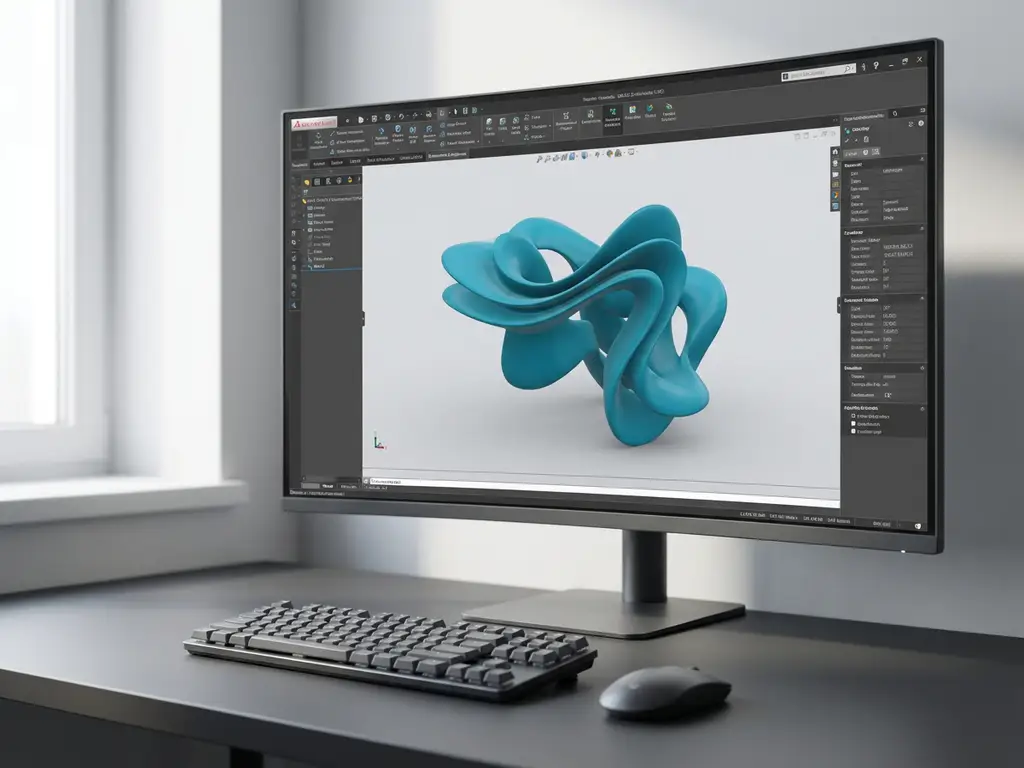
CAD software for organic shapes requires sophisticated tools that can handle complex, curved surfaces. Modern 3D CAD programs with NURBS modeling, subdivision surfaces and sculpting tools are best suited for organic design. This software offers flexible design approaches that break traditional parametric constraints and enable smooth, natural forms.
What are organic forms in CAD design and why are they so challenging?
Organic shapes are fluid, natural forms without straight lines or geometric patterns, such as leaves, human figures or ergonomic products. They differ from geometric shapes by their complex, curved surfaces, which cannot be described by simple mathematical formulas.
Traditional CAD tools struggle with organic shapes because they were originally developed for mechanical parts with straight lines and circles. These programs often use parametric modeling, where any change affects the entire design history, which can lead to instability with complex organic shapes.
The biggest challenges in organic modeling are:
- Surface continuity – Creating smooth transitions between different curved sections
- Complex topology – Organic forms often have multiple protrusions and cavities
- Editability – Making changes without disturbing the entire model
- Visualization – Correctly rendering complex reflections and shadows
Which CAD software offers the best tools for organic design?
The best CAD software for organic forms combines NURBS modeling with tools for direct manipulation. Programs such as Rhino, Fusion 360 and IronCAD offer excellent organic design capabilities thanks to their flexible approaches and advanced surface modeling tools.
Different CAD programs excel in specific aspects of organic design:
NURBS-based software such as Rhino and Alias offer the most control over complex surfaces. These tools use mathematical curves and surfaces that are perfect for automotive design and industrial design.
Subdivision modeling software such as Maya and Blender works more intuitively for artistic shapes. You start with a simple shape, which you gradually refine into complex organic geometry.
Hybrid CAD programs combine different approaches. They offer both parametric precision for technical aspects and freedom for creative design, which is ideal for product development that combines function and aesthetics.
How does organic modeling work in modern CAD software?
Organic modeling uses different techniques, each with its own advantages. NURBS surfaces provide mathematical precision for smooth surfaces, while subdivision modeling gives more artistic freedom. T-Splines combine both approaches for optimal flexibility.
Subdivision modeling starts with a basic mesh that you refine by moving vertices and adding edges. This method works intuitively because you manipulate the shape directly, without complex parameters.
NURBS surfaces use control points and curves to define mathematically exact surfaces. This gives greater control over surface quality and is essential for manufacturing, where precision is crucial.
The difference between parametric and direct modeling becomes important with organic shapes. Parametric modeling keeps track of all editing steps, which gives flexibility but also imposes restrictions. Direct modeling lets you manipulate shapes directly without history, which gives freedom but makes revisions more difficult.
Modern software increasingly combines these techniques. You can start with basic parametric geometry and switch to direct modeling for organic details, offering the best of both worlds.
Which industries benefit most from organic CAD capabilities?
The furniture, automotive, consumer electronics and architecture industries benefit most from advanced organic modeling tools. These industries require complex shapes that are both functional and aesthetically pleasing, where traditional geometric approaches fall short.
In the furniture industry, organic shapes are essential for ergonomic chairs, curved cabinets and artistic furniture. Customization is standard here, requiring flexible CAD tools that allow for quick adjustments.
Automotive design relies heavily on organic design for body, interior and aerodynamic components. The complex surfaces of modern cars require advanced surface modeling tools that can generate Class-A surfaces.
Consumer products such as smartphones, headphones and home appliances use organic shapes for better ergonomics and visual appeal. These products must also be manufacturable, which requires accurate CAD models.
Architecture is increasingly incorporating organic elements into building design. From curved facades to complex roof structures, architects need CAD software that provides both creative freedom and structural accuracy.
How IronCAD helps with organic design
IronCAD offers a unique approach to organic design with a flexible design methodology that combines direct modeling with parametric capabilities. This hybrid approach gives you the freedom to create complex organic forms without the limitations of traditional CAD software.
Key benefits of IronCAD for organic design:
- Drag-and-drop 3D functionality for intuitive shape manipulation
- Flexible history dependencies that you can turn on and off
- Advanced surface modeling tools for complex, curved surfaces
- TriBall tool for precise positioning and transformations
- Seamless integration between 2D and 3D design
For companies in the furniture industry and other sectors where organic design is crucial, IronCAD offers the perfect balance of creative freedom and technical precision. Discover how IronCAD can enhance your organic design process.