Multiphysics for IronCAD 2027
FEA simulation and kinematic connections directly in IronCAD
Multiphysics for IronCAD 2027 makes simulation within IronCAD more powerful and practical. The new version of MPIC 2027 introduces improvements for kinematic connections, direct moments and rotation control.
This allows engineers and designers to analyze motion, load and deformation earlier in the design process. That helps validate designs faster and reveal engineering risks earlier.
What is Multiphysics for IronCAD?
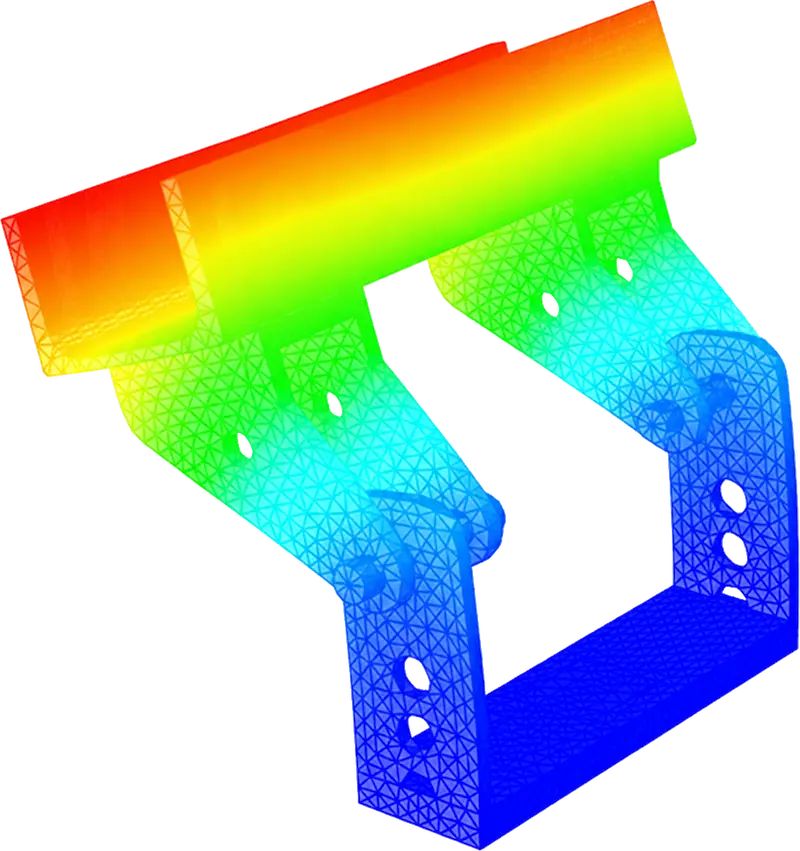
Multiphysics for IronCAD, also known as MPIC, is an integrated simulation solution for IronCAD. The software supports structural, thermal, flow, electrical and coupled analyses, among others.
Because MPIC works directly within the CAD environment, the workflow remains clear. Designs can be tested faster without switching between separate software packages each time.
Kinematic joints for realistic movement
A major innovation is the new approach for kinematic joints. Here, MPIC 2027 combines Rigid-Body Kinematics (RBK) with Finite Element Analysis (FEA).
Engineers can now define ball, hinge and piston connections, among others. These joint types are widely used in machines, cylinders, frames, lifting systems and moving structures.
Flexible working with Body, Face and Edge
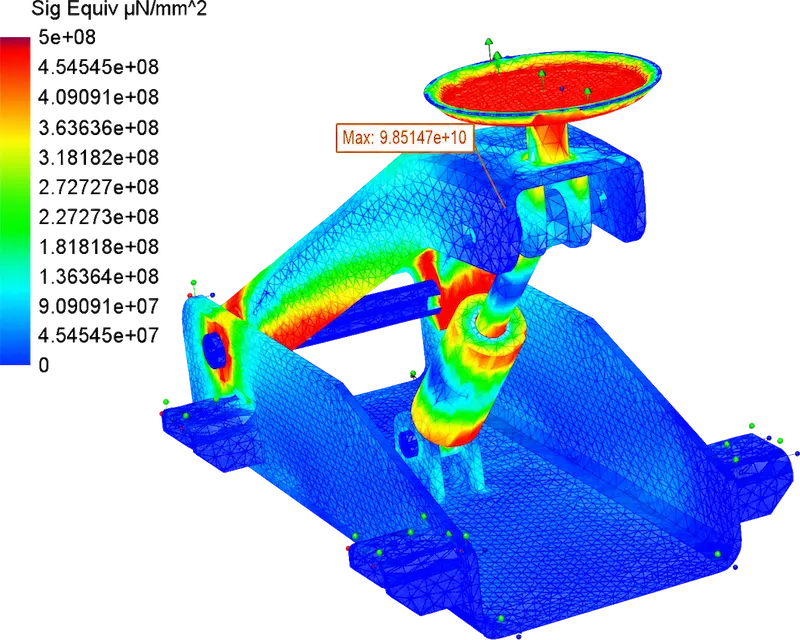
Kinematic joints can be applied to a Body, Face or Edge of the model. This gives more freedom in setting up realistic simulations.
With a Body selection, the selected geometry behaves as a rigid body. With a Face or Edge selection, the join is applied only to the selected face or edge.
The surrounding solid elements then remain deformable. As a result, results such as stress, strain, temperature and deformation remain insightful.
Less mesh complexity around connections
This new method simplifies simulations. Complex mesh refinement around hinges, axes or connection points is less often needed.
Also, the physical geometry of a joint, such as a hinge axis, does not always have to be fully present in the model. This saves time and makes the simulation setup more manageable.
Apply moments and rotations directly
MPIC 2027 also allows moments and rotations to be defined directly. In traditional solid-element FEA, this is often difficult because native rotational degrees of freedom are missing.
MPIC 2027 allows moments and rotation constraints to be applied to a Body, Face, Edge or Curve. Detours with force pairs are therefore no longer necessary.
Practical examples are a drive torque, drilling torque, pivot load or rotation around a specific axis.
Faster validation with more certainty
These new features make simulation more useful during design. Moving parts can be analyzed more realistically, while important FEA results remain visible.
For mechanical engineering, metalworking, equipment manufacturing and industrial engineering, this means less manual rework, faster validation and more informed design choices.
Discover MPIC 2027 for IronCAD
Multiphysics for IronCAD 2027 brings advanced simulation closer to everyday CAD workflow. Kinematic connections, instant moments and rotation control help test designs faster and more realistically.
Discover how MPIC 2027 helps analyze motion, load and deformation faster within IronCAD. Request a trial version or contact IronCAD specialist for a demo.